Research committee
Important decisions should not rely on a single model. The research committee has multiple models answer the same question in parallel, after which a reviewer model synthesizes each model's answer into consensus, disagreement, unique perspectives, and blind spots — a comparison, not a vote — with a synthesis model finally producing a finished answer. For technology selection, solution review, competitive analysis, or seeking a dissenting opinion on a high-stakes decision, this is more reliable than repeatedly pressing a single model.
It is a "Q&A / research" style of multi-model collaboration, distinct from Fusion's "code contest": what is produced here is a conclusion, not code. The multi-model capability is provided by Comate Zulu — a single license can call more than a dozen models.
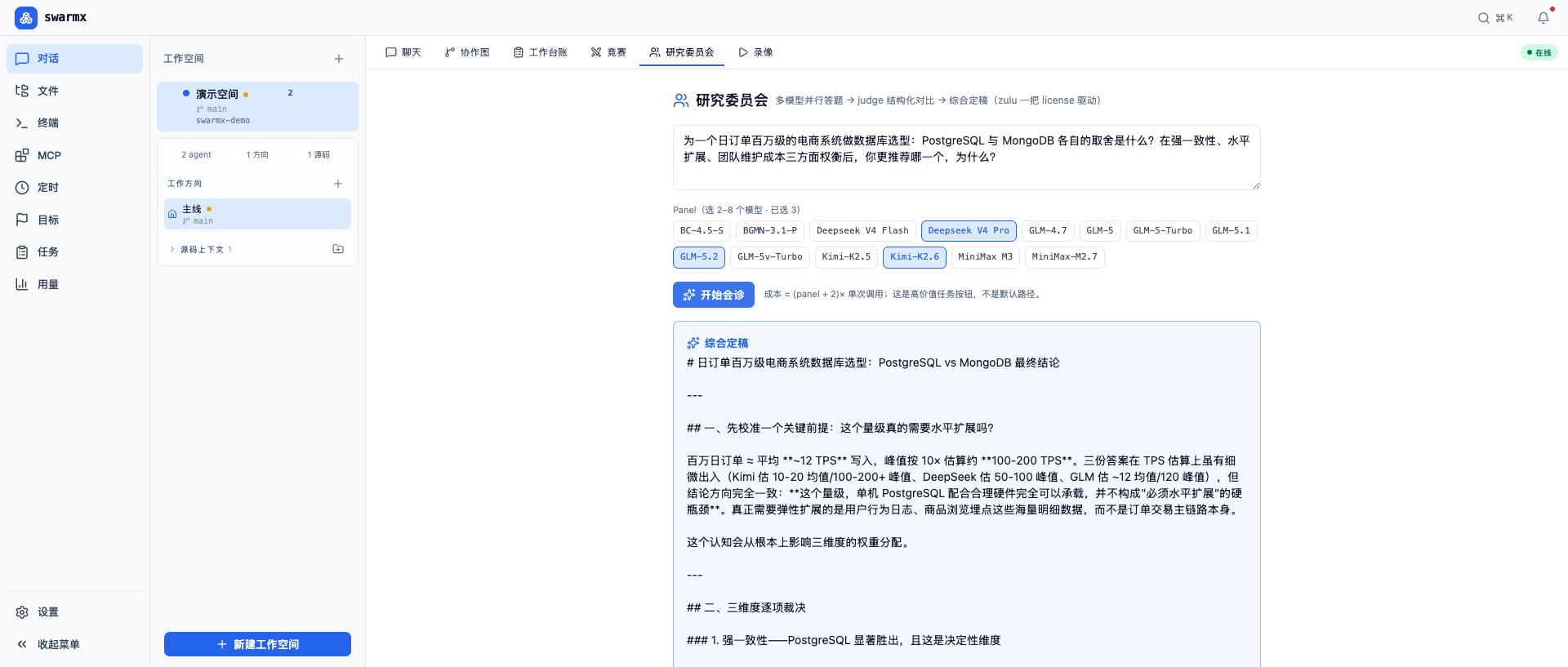
How to use it
- Open the workspace's "Research committee" tab.
- Enter a question worth a multi-model consultation.
- Select 2 to 8 models to form the participating lineup (a cross-vendor combination is provided by default, falling back to the first few available models when some are missing).
- Click "Start consultation" and wait about 1 to 2 minutes.
What happens behind the scenes
- Answering in parallel — each selected model answers the same question independently, executing in parallel. As long as one model produces an answer, the process continues; it errors only if all fail.
- Structured comparison — a reviewer model synthesizes each model's answer into four dimensions: consensus (points the majority agree on), disagreement (points that contradict one another), unique perspectives (points only one model raised), and blind spots (important aspects none considered). It is explicitly required to compare, not to vote, and not to stitch answers together.
- Synthesized final answer — a synthesis model writes a final answer based on the comparison above: consensus as the backbone, the better side of each disagreement with reasons, unique perspectives incorporated, and blind spots filled — a fresh piece of writing, not a simple stitch.
The result contains
- Synthesized final answer — the final answer given by the synthesis model.
- Structured analysis — the four columns of consensus / disagreement / unique perspectives / blind spots, each with an item count.
- Raw answers — each model's full response and elapsed time, which can be expanded and compared one by one; failed models are also flagged.
Cost
A single consultation is roughly equivalent to "number of models + 2" single-model calls (N participating models, plus one synthesis-of-comparison and one synthesis). This is a capability aimed at high-value decisions, not a default everyday path — use it when a more reliable conclusion is worth several times the cost.
Prerequisites
You must first install Zulu and configure a Comate license. If it is not yet configured, the model list is empty and the page prompts you to go to "Settings → Plugins." See Install Zulu and configure a license for details.